

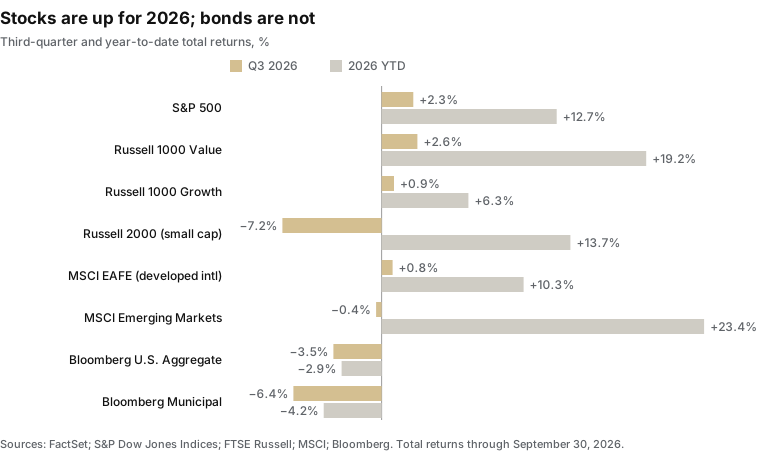
The S&P 500 gained 2.3% in the third quarter and is up 12.7% for the year. The headline return was modest. The forces driving markets were not. The Federal Reserve raised rates for the first time since 2023. The 10-year Treasury yield finished near 5.3%, its highest since 2007. Oil spent most of September above $100 a barrel as the June ceasefire framework with Iran came apart. The market's gain came almost entirely from a handful of companies while the rest of the index fell. And the index is cheaper today, relative to expected earnings, than it was a year ago, because earnings forecasts rose faster than prices did.
Every one of those comes back to the price of money. For three years, markets assumed rates would eventually drift lower. This quarter repriced that assumption, and the repricing reaches beyond your portfolio.
The quarter in numbers
The 10-year Treasury yield ended the quarter at 5.29%, up about 0.85 points in three months and nearly a full point since spring. WTI crude finished near $90 after touching $107 in mid-September.
Seven stocks carried the index
The seven companies known as the Magnificent 7 returned 11.1% in the quarter. The other 493 companies in the S&P 500 fell 2.2%. Microsoft alone rose 33% as money rotated out of semiconductors and into software, and by one estimate was responsible for most of the index's gain.
Beyond those names, the quarter sorted everything else into three groups.
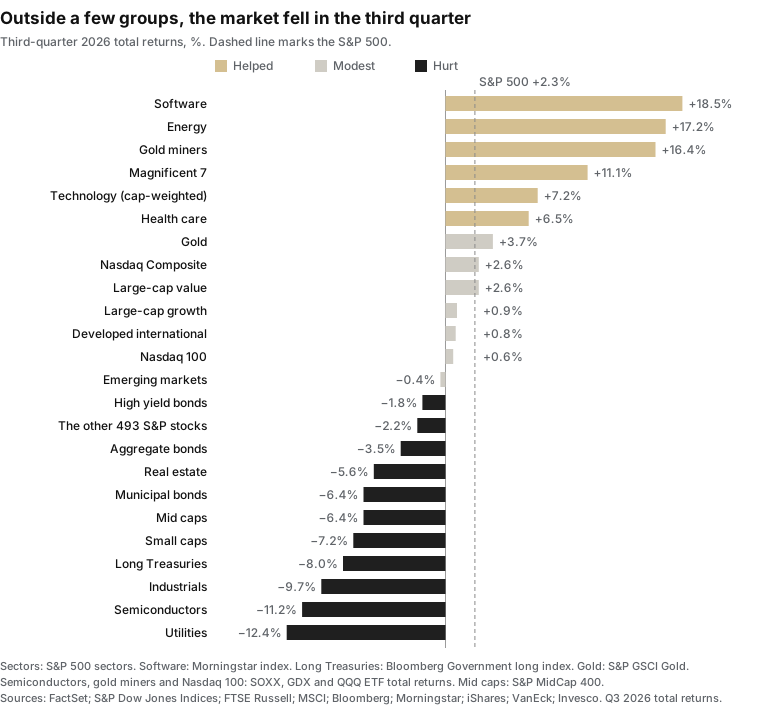
The sorting was not random. The first group is mostly companies whose earnings estimates rose faster than the discount rate did, plus energy and gold miners, which rose with the commodities. The second group is broad exposure, which owns the winners and the losers together. The third group is where higher rates bit hardest: anything whose value depends on a fixed payment, a leveraged multiple, or cheap refinancing, plus semiconductors giving back part of a 95% second quarter. The cost of money was the main dividing line, not the only one.
The further a portfolio sat from the first group, the lower its return for the quarter, with or without bonds. Several of the areas that lagged remain well ahead of the S&P 500 for the year: value is up 19% against 6% for growth, small caps are ahead of large, and emerging markets are up 23%. That is what index concentration looks like from inside a portfolio built to own more than seven companies.
Bonds had their worst quarter in years, and the index now yields 5.6%
The Bloomberg Aggregate fell 3.5%, municipals fell more than 6%, and long Treasuries lost 8%. Yields rose for reasons that are mostly still in place. Headline inflation was 3.4% in August, with oil pushing it higher; the Fed hiked and signaled it may not be finished; federal debt crossed $40 trillion; and the companies building AI infrastructure have issued more than $200 billion of long term bonds this year, competing with the Treasury for the same capital.
The same move that lowered prices raised yields. The aggregate bond index had a yield to maturity of 5.6% at quarter end, well above inflation and, outside a brief stretch in late 2023, the highest in well over a decade. Starting yield has historically been the best single guide to what bonds return over the following several years, and it just improved. When the 10-year last touched 5% in October 2023, the Agg returned about 15% over the following three years.
If you are living on your portfolio rather than a paycheck, whether because you retired, sold a business, or inherited, this is the most important change of the year. For most of the past fifteen years, bonds paid so little that a conservative portfolio could not support much spending without help from stocks. At 5.6%, it can.
Earnings are why stocks held up
S&P 500 earnings are expected to grow about 32% in 2026 and 15% in 2027, led by technology and energy. Because earnings estimates rose faster than prices, the index's forward P/E fell from roughly 23x a year ago to 19x, near its long-run average, even as the index rose. That is unusual, and it is the main reason stocks absorbed a Fed hike and almost a point rise in the 10-year without more damage. Cheaper is relative, though. A 19x multiple is an earnings yield of about 5.3%, roughly what a 10-year Treasury now pays. The two are not directly comparable, since earnings can grow and coupons cannot, but the gap between them is close to zero. The case for stocks over Treasuries now rests on earnings growing as forecast, not on the price being paid today.
Those earnings are also the main risk, because the valuation case depends on forecasts that have not arrived yet. The largest cloud companies are projected to spend $800 billion on capital expenditure this year and $1.1 trillion next. A slowdown there would hit the earnings of the companies supplying it, and the weaker borrowers who financed data centers on the assumption that the spending continues. Treasuries are the asset that has historically held up when growth slows, which is the reason to own them alongside the risk.
If you own a business, the 10-year is your number too
Public market investors watch the 10-year yield because it is a primary reference point for valuing future cash flows. Private business owners should watch it for the same reason, with a lag.
A buyer of a private company, whether a strategic acquirer, a private equity sponsor, or a successor using bank or SBA debt, sets a price partly from their cost of capital. With a 10-year at 4%, a sponsor can pay a higher multiple and still make leveraged math work. At 5.3%, the same deal needs a lower price or more equity. Private multiples adjust more slowly than public ones, so this quarter's move in the bond market is still working its way into the private market.
If a transaction is on your horizon in the next few years, the environment has become less forgiving, and the gap between a prepared business and an unprepared one will matter more. If you are the buyer, cash is worth more than it was: buyers with strong balance sheets gain negotiating room, while buyers who depend on financing face the same higher hurdle. Either way, part of what your business is worth is now being decided in the Treasury market, a market you have probably never traded in. That is one more reason the wealth you have already taken out of the business should not carry the same rate sensitivity as the business itself.
What this quarter changed, and what it didn't
Three things changed this quarter. One thing that feels like it should have changed did not.
Bond losses may be a tax asset, through December 31. Municipal and investment grade bond benchmarks are down roughly 3% to 4% this year, more for longer maturities. In a taxable account, a position bought before yields rose may carry a loss that can be realized and the exposure replaced with something comparable but not substantially identical at today's higher yield, staying clear of the 30-day wash-sale window on either side of the sale.
Known liabilities got cheaper to fund. A tax bill from a sale, a buyout installment, a tuition contract: an obligation with a known date and dollar amount can be funded with Treasuries that mature when it is due. Higher yields cut what that costs today. Before taxes, a dollar due in ten years costs about 61 cents at a 5% yield and about 82 cents at 2%.
Estate planning math shifted. The IRS rates that govern wealth transfer techniques track Treasury yields, and they have risen with them. That raises the hurdle for newly funded GRATs and for new intra family loans and installment sales, and it improves the gift tax arithmetic for QPRTs and the charitable deduction for annuity-style charitable remainder trusts. Term arrangements already in place generally keep the rate they were set up with. Anyone planning new ones should rerun the numbers.
Higher yields are not, by themselves, a reason to sell stocks. The intuitive move at 5.6% is to shift from equities into bonds. The long run evidence doesn't support it as a market call: the premium stocks have earned over Treasury bills has been roughly the same in high rate years and low rate years, because higher rates raise expected returns on both. What higher yields do change is how much risk a plan needs. Reducing equity because a goal can now be funded with less of it is a planning decision, and a sound one. Reducing it because stocks look expensive next to bonds is a forecast.
A closing thought
In January, futures markets expected the fed funds rate to end 2026 near 3%. The top of the target range is now 4%, and markets price it above 4.25% by year end. The Fed hiked on September 16. Two weeks later, the jobs report showed September added 29,000 jobs. This is a tightening aimed at inflation that oil has kept elevated, not a response to runaway hiring, and the Fed cannot control oil. The consensus forecast was wrong in the same direction all year.
The cost of money changed this year, and it changed more than prices. It changed what a plan requires: what a future payment costs to fund, which estate strategies still clear their hurdle, what a buyer can pay for a business. The plans that held up did not have a better forecast. They were the ones where the personal balance sheet was not riding on the same rate as the business, where the next few years of spending were already set aside, and where the estate moves were made while the hurdle was lower. None of that shows up in a quarterly return, and all of it is what this quarter rewarded. November's midterms and an earnings season beginning in mid October will test it again.
Sources: FactSet; S&P Dow Jones Indices; FTSE Russell; MSCI; Bloomberg; Morningstar; iShares, VanEck and Invesco (ETF total returns); J.P. Morgan Asset Management (corporate bond issuance); Dimensional Fund Advisors; CME FedWatch; Federal Reserve Board, FOMC Statement (September 2026); U.S. Bureau of Labor Statistics. Market data as of September 30, 2026; economic releases through October 2, 2026.
This commentary is for informational purposes only and does not constitute investment advice.
